
Azure event-driven architecture diagram
The short version: This template shows an event-driven architecture on Azure — events flow through Event Grid, Service Bus or Event Hubs into Azure Functions, which react and write to downstream stores. Decoupled and reactive. Free and editable in Calma Studio, with export to Bicep, Terraform or ARM. Open this template →
What it shows. Producers emit events into a messaging backbone — Event Grid for discrete events, Service Bus for reliable queuing, or Event Hubs for high-volume streams. Azure Functions consume them and react, writing to downstream stores (Cosmos DB, Storage) or triggering further workflows. Everything is decoupled: producers don't know about consumers.
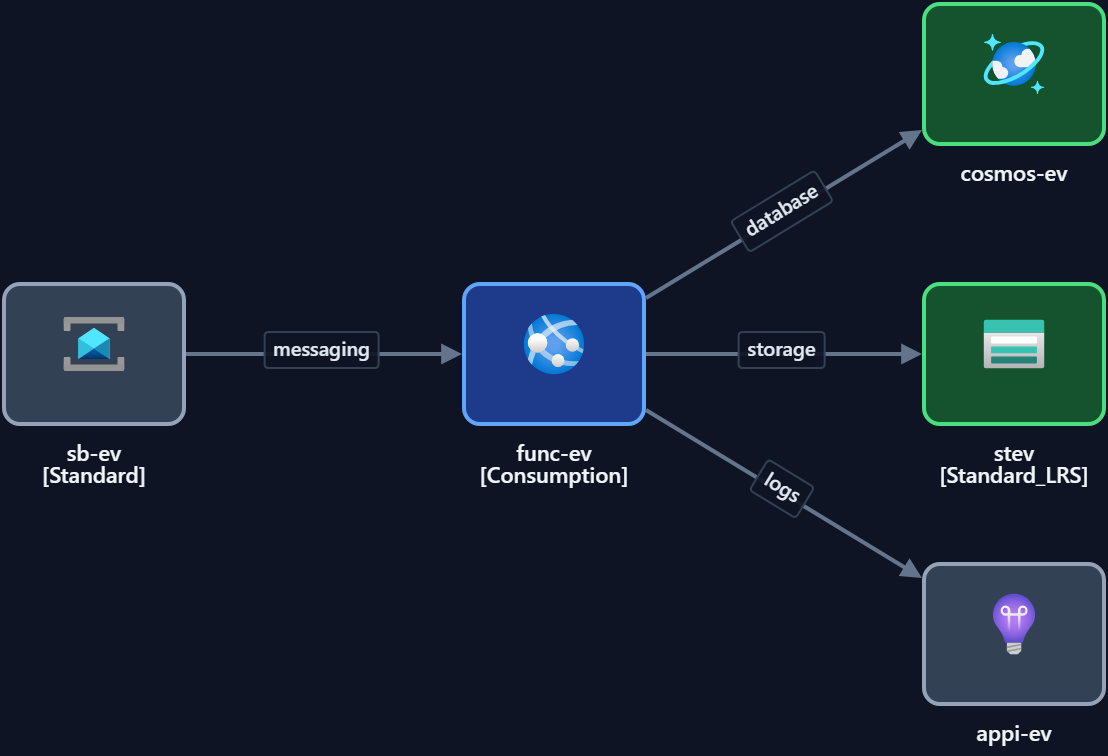
Key components
| Component | Role |
|---|---|
| Event Grid / Service Bus / Event Hubs | The messaging backbone (choose per need) |
| Azure Functions | Event consumers that react and process |
| Cosmos DB / Storage | Downstream data stores |
| Key Vault | Secrets for connections |
| Application Insights | Tracing across the event flow |
When to use it. Reactive, decoupled workloads — ingestion pipelines, integrations, fan-out processing — where producers and consumers should scale and evolve independently.
When not to. A simple synchronous request/response app doesn't need an event backbone; a straightforward web app is simpler.
Make it yours. Open it in Studio, pick your messaging service, set regions and tags, then export to code.
Open the event-driven template — free →
FAQ
- Event Grid, Service Bus or Event Hubs — which one? Event Grid for discrete event routing, Service Bus for reliable ordered queuing, Event Hubs for high-throughput streaming. The template shows the pattern; swap in the one you need.
- Why event-driven instead of direct calls? It decouples producers from consumers so each scales and changes independently.
- Can I export it to IaC? Yes — Bicep, Terraform or ARM from Studio.
- Is it free? Yes, free and editable, no signup.